Spray Foam Roof Application
Seamless SPF sprayed over your existing roof — insulation and waterproofing in one monolithic, self-flashing layer with a high R-value.
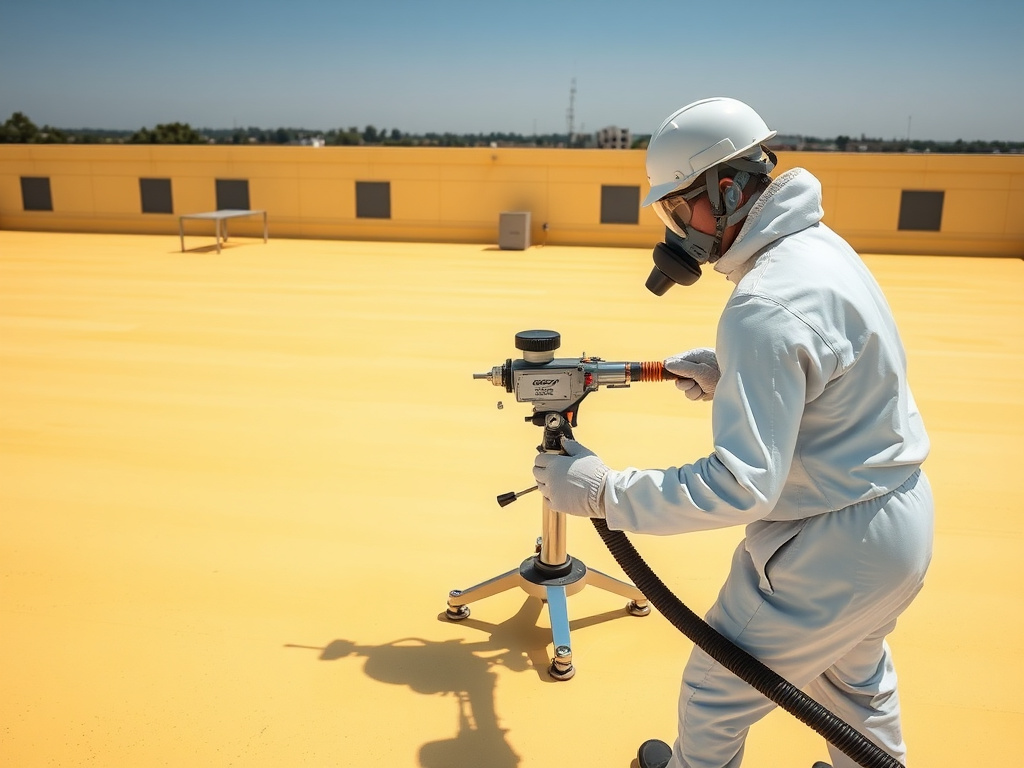
Spray polyurethane foam roof application is the heart of what we do. Two liquid components are combined at the spray gun and applied directly to your roof, where they expand in seconds into a rigid, closed-cell foam that adheres to the substrate and forms one continuous, monolithic surface. Unlike membrane or built-up roofs assembled from panels and seams, an SPF roof has no seams to split, no fasteners to back out, and no laps to fail — it's a single sprayed layer that wraps every penetration, curb, and edge.
That seamless, self-flashing quality is exactly why SPF has become the go-to system for commercial and industrial flat and low-slope roofs. It insulates and waterproofs at the same time, it can be applied over most existing roofs without a tear-off, and — protected by a reflective coating — it delivers one of the longest, most renewable service lives in the roofing industry.
Key benefits
- Seamless, monolithic surface — no seams or laps to leak
- Self-flashing around penetrations, curbs, and edges
- Insulation and waterproofing in a single system
- High R-value (about R-6.5 per inch of closed-cell foam)
- Lightweight — adds minimal load to the structure
- Applies over most existing roofs, avoiding tear-off
How SPF roofing is applied
A quality SPF application is a controlled, weather-dependent process. The existing roof is cleaned and prepared, any wet or failed areas are addressed, and the substrate is verified for adhesion. The two-component foam is then sprayed to a specified thickness — typically one to two inches or more depending on the R-value and slope goals — building the roof up as a single continuous layer. Because the foam is self-flashing, our crews spray it right up and over curbs, vents, pipes, and parapet walls, sealing the exact transitions where conventional roofs leak.
Once the foam is in place and cured, it's immediately protected with a coating (silicone or acrylic) and often a granule broadcast for walkability and UV protection. That coating is what gives the system its reflectivity, its UV resistance, and its renewable warranty.
- Clean and prepare the existing roof
- Verify adhesion and correct any wet areas
- Spray foam to the specified thickness in one layer
- Coat and granulate to protect and finish the system
Why seamless matters
The overwhelming majority of roof leaks start at a seam, a fastener, a lap, or a flashing detail around a penetration. Those are the joints where conventional roofing systems are most vulnerable. SPF eliminates them. Because the foam is sprayed as a liquid and cures into one solid piece, there are simply no seams to fail and no separate flashings to come loose. Every pipe, drain, HVAC curb, and skylight is encapsulated in the same continuous membrane as the rest of the roof.
For a building owner, that translates directly into fewer leaks, fewer callbacks, and a roof that performs as one integrated system rather than an assembly of parts that can each fail independently.
Adhesion, wind, and durability
A properly applied SPF roof is fully adhered to the substrate across its entire surface, which gives it exceptional wind-uplift resistance — there's no space beneath it for wind to get under and peel it back the way it can with mechanically-attached membranes. The rigid closed-cell foam also adds compressive strength and helps the roof resist foot traffic and hail. With a maintained coating, an SPF roof routinely delivers decades of service, and its lifecycle can be extended almost indefinitely through periodic recoats.
Ideal for
- Commercial and industrial flat or low-slope roofs
- Warehouses, distribution centers, and manufacturing
- Buildings with many rooftop penetrations to seal
- Owners wanting to add R-value while re-roofing
- Roofs being restored instead of replaced
What affects the cost
SPF Roof Application questions, answered
A properly installed and maintained SPF roof can last 30 years or more — and effectively indefinitely, because the system is renewable. When the protective coating wears over time (typically 10–20 years depending on the coating and thickness), a recoat restores the roof and renews the warranty without removing the foam. That renewable lifecycle is one of SPF's biggest advantages over single-ply and built-up roofs.
In most cases, yes. SPF is lightweight and can be applied over many existing roof types — metal, built-up, single-ply, and more — as long as the substrate is sound and dry after any needed repairs. This 'recover' capability avoids the cost, disruption, and landfill waste of a full tear-off, which is one of the main reasons owners choose SPF.
Closed-cell SPF roofing provides roughly R-6.5 per inch — among the highest of any insulation used in roofing. Because you choose the foam thickness, you can build in as much R-value as your energy goals and budget call for, adding insulation and waterproofing in the same step.
Yes. A fully-adhered SPF roof resists wind uplift exceptionally well, adds compressive strength that helps it stand up to foot traffic and hail, and — protected by its coating — resists UV and weathering for decades. Maintained properly, it's one of the most durable and longest-lived commercial roof systems available.
SPF Roof Application done right, by SPF roofing specialists
SPF Roof Application is a technical, weather-dependent process, and the result depends entirely on how carefully the roof is assessed, prepped, and applied. We do it the right way — an honest inspection first, proper preparation and adhesion, foam and coating applied to the specified thickness, and full documentation so your warranty is backed. No shortcuts, no under-applied coating to shave the price.
We work with commercial, industrial, and residential building owners nationwide, and we'll give you a clear, transparent scope and quote rather than a vague number. Whether it's one building or a portfolio of roofs, every project starts with a free assessment.
Just as important, we think about the whole lifecycle of your roof. Spray foam is renewable — its real value comes from being maintained and recoated over decades rather than replaced on a cycle. When we scope your spf roof application, we set the roof up to be protected for the long term, so you get the lowest lifetime cost and the fewest surprises. That long-view approach is what building owners and facility managers count on us for.
Free assessment
We inspect the roof, check for moisture, and give you a clear, transparent scope and quote.
Expert application
We prep and install your spf roof application to spec — seamless, warranted, and documented.
Protected for decades
A maintenance plan and timely recoats keep the roof renewable and under warranty for the long haul.
Related services
Ready for a free spf roof application assessment?
Tell us about your building and roof and we'll put together a clear scope and quote — no tear-off assumptions, no pressure.